Key Person Insurance: What Happens to Your Business When Your Star Employee Can't Work?
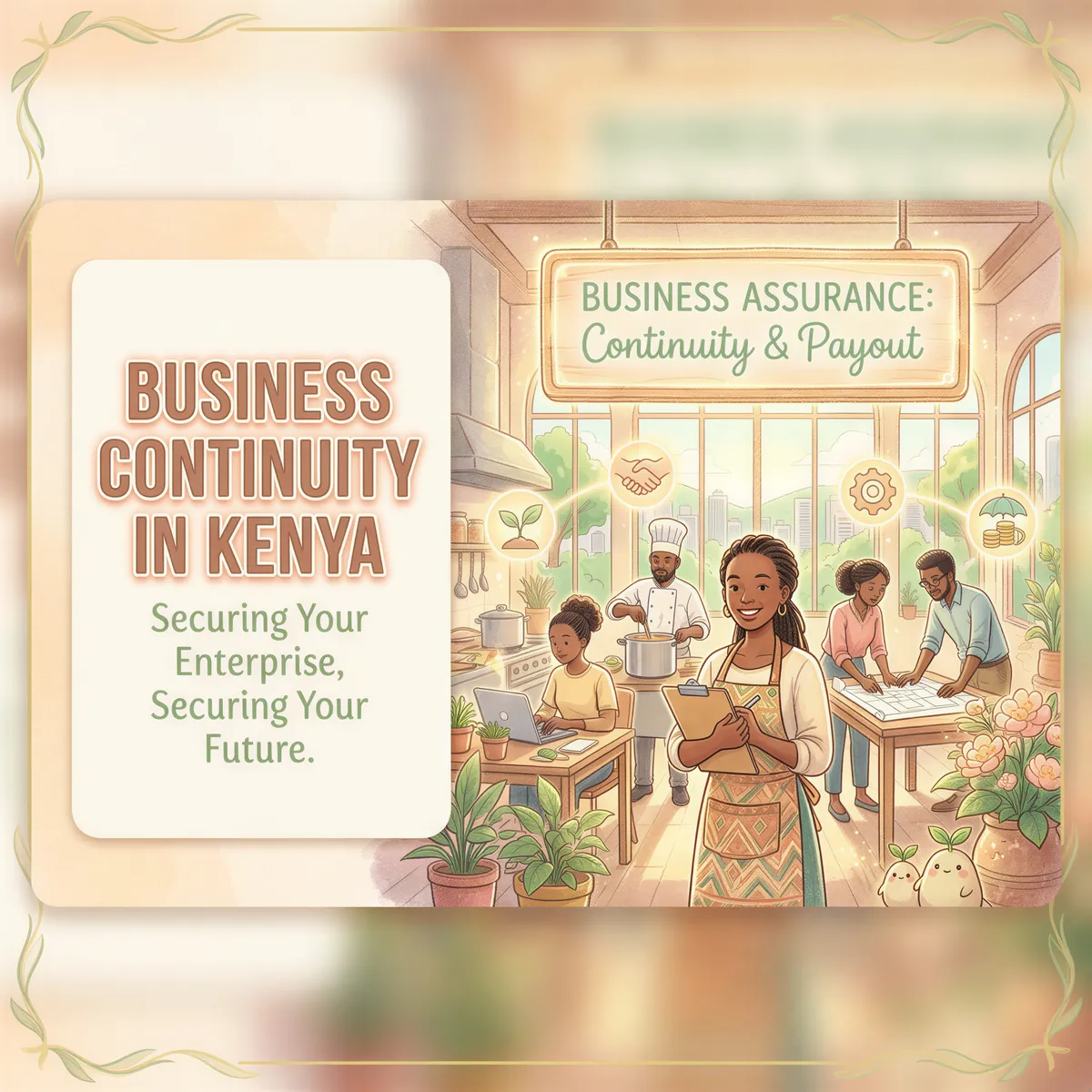
Picture this.
You run a restaurant in Westlands. Business is good. Reviews are great. Bookings are full every weekend.
Then your head chef — the reason people keep coming back — gets into a serious car accident. He's alive, but he won't be working for at least eight months.
Within weeks:
- The menu quality drops
- Regulars stop showing up
- Revenue falls by 40%
- You're scrambling to recruit a replacement — at a premium salary
- Your landlord doesn't care. Rent is still due.
This is not a staffing problem. This is a business survival problem.
And it's exactly what key person insurance is designed to solve.
Table of Contents
- What Is Key Person Insurance?
- Who Counts as a "Key Person"?
- Real Scenarios: When Key People Disappear
- How Key Person Insurance Works
- How Much Does Key Person Insurance Cost in Kenya?
- Key Person Insurance vs. Life Insurance
- When Do You Need Key Person Insurance?
- How Key Person Insurance Connects to Business Interruption
- Final Word: Your Business Is Only as Strong as Its People
What Is Key Person Insurance?
Key person insurance is a life and disability insurance policy taken out by a business on one or more of its most important people.
The business pays the premiums. The business is the beneficiary.
If the key person dies, becomes critically ill, or is permanently disabled, the business receives a lump sum payout.
That money helps the business:
- Survive the disruption — cover lost revenue during the transition
- Recruit a replacement — hiring senior talent takes time and money
- Pay off debts — loans, rent, supplier obligations
- Reassure stakeholders — investors, partners, and clients
- Stay afloat — keep the lights on while you rebuild
Key person insurance is not for the individual. It's for the business that depends on them.

Who Counts as a "Key Person"?
A key person is anyone whose absence would cause significant financial harm to the business. This could be:
- The founder or CEO — especially in small and medium businesses where the founder IS the business
- The lead salesperson — the one who brings in 50% of your revenue
- The head chef — whose skills are the reason your restaurant exists
- The lead developer — the only person who truly understands your tech stack
- The creative director — whose vision drives your brand
- A specialist consultant — with relationships and knowledge that can't be easily replaced
How to identify your key people:
Ask yourself:
- If this person disappeared tomorrow, would the business lose significant revenue?
- Would clients leave?
- Would we struggle to deliver our core product or service?
- Would it take months (not weeks) to find a replacement?
If the answer to any of these is yes, that person is a key person.

Real Scenarios: When Key People Disappear
Scenario 1: The Tech Startup
A Nairobi fintech has three co-founders. One handles the technology — all of it. He's the CTO, lead architect, and primary coder.
He's diagnosed with cancer and needs six months of treatment.
The company has:
- An app that needs constant updates
- Investors expecting milestones
- No one else who understands the backend
Without key person insurance: The company burns through savings trying to hire contract developers at double the cost. They miss their next funding round. The startup folds.
With key person insurance: The payout covers hiring a senior contractor, extends the runway, and buys time to restructure the tech team.
Scenario 2: The Family Business
A family-run wholesaler in Mombasa depends on the patriarch. He knows every supplier. Every client relationship goes through him. He handles all the banking.
He passes away suddenly.
The family inherits the business but has no idea:
- Who owes them money
- Which suppliers give them credit
- How the cash flow works
Without key person insurance: The business collapses within months. Debts pile up. Suppliers cut them off.
With key person insurance: The payout gives the family breathing room — cash to hire a manager, time to learn the business, money to keep suppliers happy.
Scenario 3: The Top Salesperson
A real estate agency in Karen has one agent who closes 60% of all deals. She's their rainmaker.
She has a severe stroke and can't work.
Clients who were mid-deal start looking elsewhere. New leads dry up. Revenue drops by more than half.
Without key person insurance: The agency can't cover rent and salaries. Two other agents leave. The business shrinks permanently.
With key person insurance: The payout covers the revenue gap for 6–12 months, funds recruitment of two replacement agents, and keeps the office running.
How Key Person Insurance Works
The mechanics are straightforward:
- The business identifies key people
- The business applies for a policy on each key person (with their consent)
- The business pays the premiums — this is a business expense
- If the key person dies or is disabled, the business receives the payout
- The business uses the money however it needs to — there are no restrictions
What it typically covers:
- ✔️ Death of the key person
- ✔️ Permanent disability
- ✔️ Critical illness (depending on the policy)
- ✔️ Temporary disability (some policies)
What determines the payout amount:
The sum insured is usually based on:
- The key person's annual contribution to revenue
- Replacement costs — salary, recruitment fees, training
- Loan obligations — some banks require key person insurance as a condition of business loans
- A multiplier — typically 2–5 times the person's annual economic value to the business

How Much Does Key Person Insurance Cost in Kenya?
Premiums depend on:
- Age and health of the key person
- Sum insured — how much the payout would be
- Policy type — life only, or life + critical illness + disability
- Industry risk — a construction site foreman vs. an office-based consultant
Typical ranges for Kenyan businesses:
- KSh 10 million cover: KSh 15,000 – 40,000/year
- KSh 25 million cover: KSh 35,000 – 90,000/year
- KSh 50 million cover: KSh 70,000 – 200,000/year
For most SMEs, this is a tiny fraction of what they'd lose if that key person was suddenly gone.
A premium of KSh 3,000/month to protect against a KSh 10 million business disruption. That's not an expense — that's common sense.

Key Person Insurance vs. Life Insurance
These are related but different.
| Key Person Insurance | Personal Life Insurance | |
|---|---|---|
| Policyholder | The business | The individual |
| Beneficiary | The business | Family/dependants |
| Purpose | Protect the business from financial loss | Protect the family from financial loss |
| Premiums paid by | The business | The individual |
A key person should have both: personal life insurance for their family, and key person insurance for the business they're critical to.
👉 For more on personal coverage, see our life insurance basics guide.
When Do You Need Key Person Insurance?
If any of these apply to your business, it's time:
- ✔️ Your business has one or two people who are critical to operations
- ✔️ You have business loans that depend on your continued ability to operate
- ✔️ Investors have asked about business continuity plans
- ✔️ You're a partnership where one partner's exit could collapse the business
- ✔️ You depend on a specialist who would be hard to replace
- ✔️ Your business would struggle to survive 6+ months without a specific person
How Key Person Insurance Connects to Business Interruption
Key person insurance covers the people risk. But businesses face other disruptions too — fires, floods, supply chain failures.
That's where business interruption insurance comes in. It covers revenue loss from physical disruptions to your operations.
Together, key person and business interruption insurance create a comprehensive business continuity safety net.
Think of it this way:
- Key person insurance = what if your best person can't work?
- Business interruption insurance = what if your premises can't operate?
Smart businesses cover both.
Final Word: Your Business Is Only as Strong as Its People
Every business owner knows who their irreplaceable people are. The ones you'd panic about losing. The ones whose departure would change everything.
Key person insurance doesn't prevent loss. But it gives your business the financial breathing room to survive it.
The question isn't whether you can afford key person insurance.
The question is whether your business can afford to lose a key person without it.
🟢 Protect your business from its biggest risk — losing the people who make it run. Learn more in our key person insurance guide and explore how to keep your business resilient.
Ready to Get Started?
Get personalized advice and quotes tailored to your needs. No pressure, just honest guidance.
👉 Or start a chat with our assistant now.