Your Business Has Employees? Here's the Insurance You're Legally Required to Have
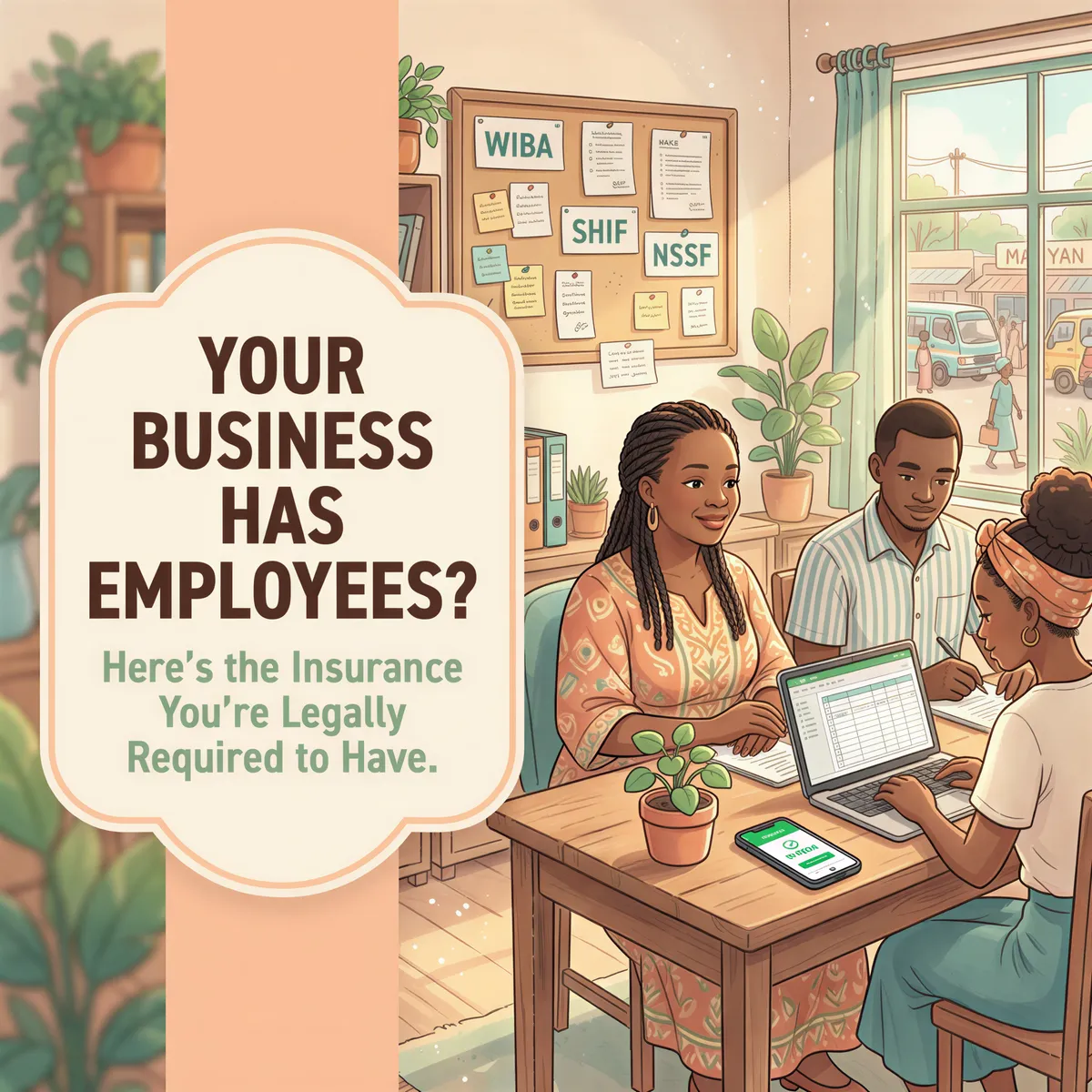
You hired your first employee last year. Maybe two. Maybe ten.
You sorted their salary. Set up M-Pesa payroll. Even gave them a decent workspace.
But here's what most Kenyan business owners forget — or don't know:
The moment you have employees, certain types of insurance are not optional. They're the law.
And the penalties for non-compliance? They're not gentle.
This guide breaks down exactly what insurance your business legally needs, what's recommended but optional, and what happens if you ignore the rules.
Table of Contents
- The Big One: WIBA (Work Injury Benefits Act)
- What Happens If You Don't Have WIBA?
- SHIF (Social Health Insurance Fund) Contributions
- NSSF (National Social Security Fund)
- Group Medical Insurance: Required or Not?
- General Liability Insurance
- Professional Indemnity Insurance
- The Full Compliance Checklist
- The Cost of Getting It Wrong
- How to Get Compliant (Step by Step)
- Final Word: Compliance Isn't Just About Avoiding Fines
The Big One: WIBA (Work Injury Benefits Act)
Let's start with the one that catches most small business owners off guard.
The Work Injury Benefits Act (WIBA), 2007 requires every employer in Kenya — yes, even the one with just one employee — to compensate workers for:
- ✔️ Injuries sustained at work
- ✔️ Diseases contracted due to work
- ✔️ Death arising from employment
This isn't optional. It's not a "nice to have." It's a legal obligation from day one.
What WIBA Covers
| Situation | What's Required |
|---|---|
| Temporary disability | Pay at least 50% of earnings during recovery |
| Permanent disability | Lump sum based on degree of disability (up to KSh 5.8M+) |
| Death | Minimum compensation to dependants (up to KSh 5.8M+) |
| Medical expenses | Cover reasonable medical costs related to the injury |
How Most Businesses Handle It
You buy a WIBA insurance policy from a licensed insurer. The insurer takes on the financial risk if an employee is injured or killed at work.
Premiums depend on:
- Number of employees
- Nature of work (construction is riskier than office work)
- Annual payroll
For a small office-based business with 5 employees, expect to pay KSh 10,000-30,000/year for WIBA cover.
For more details on workers' compensation policies, see our workers' compensation insurance page.
What Happens If You Don't Have WIBA?
This is where it gets serious.
Under the WIBA Act:
- ❌ You can be fined up to KSh 100,000
- ❌ You can face imprisonment of up to 3 months
- ❌ You become personally liable for all compensation costs
- ❌ Your business can be shut down by a labour inspector
A construction worker falls from scaffolding. No WIBA policy. The employer now owes millions in compensation — out of pocket. Plus a criminal charge. This happens in Kenya. Regularly.
Don't be that employer.
SHIF (Social Health Insurance Fund) Contributions
Under the Social Health Authority Act, 2023, both employers and employees must contribute to SHIF.
Here's how it works:
- Employees contribute 2.75% of their gross salary
- Employers are responsible for deducting and remitting contributions
- Failure to remit is an offence
This replaced the old NHIF system. And while SHIF isn't "insurance" in the traditional sense, your obligation as an employer to deduct and remit is legally binding.
Penalties for Non-Compliance
- Late remittance: Interest penalties
- Failure to register employees: Fines and potential prosecution
- Consistent non-compliance: Business licence issues

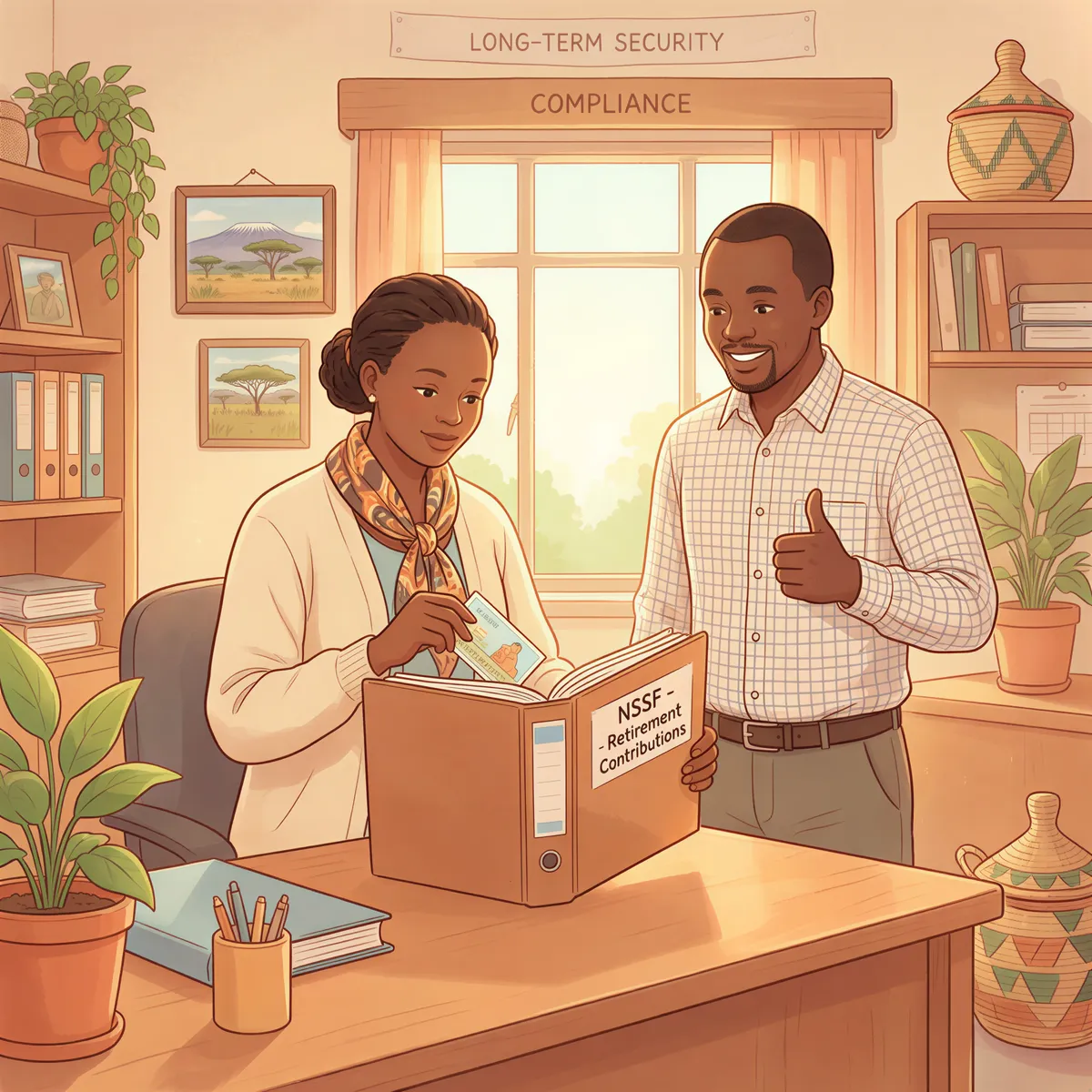
NSSF (National Social Security Fund)
Under the NSSF Act, 2013, employers must register with NSSF and contribute on behalf of employees.
Current contributions:
- Employee: 6% of pensionable pay (up to a cap)
- Employer: Matching 6% contribution
This is a retirement savings scheme, not insurance. But the legal requirement to contribute is just as binding as WIBA.
Non-compliance penalties include fines, interest on arrears, and potential prosecution.
Group Medical Insurance: Required or Not?
Here's where it gets nuanced.
Group medical insurance is not legally mandated in Kenya. There's no law that says "you must buy private medical cover for your employees."
However:
- Many collective bargaining agreements (CBAs) require it
- Some industry regulators expect it
- The Employment Act requires employers to provide a "safe and healthy working environment" — which courts have sometimes interpreted broadly
- Large employers are practically expected to provide it
Why Smart Employers Provide It Anyway
- Attracts and retains talent (especially in competitive sectors)
- Reduces absenteeism — employees who can see a doctor don't sit at home hoping it goes away
- Demonstrates compliance culture
- Costs less than you think for small groups
Even a basic group medical plan for 5-10 employees can start from KSh 15,000-25,000 per person per year, depending on the insurer and benefit limits.
Explore your options on our group insurance solutions page.

General Liability Insurance
Not strictly required by law for all businesses, but practically essential — and required in many contexts:
- ✔️ Required for government contracts and tenders
- ✔️ Required by many landlords for commercial leases
- ✔️ Required for some professional licences
- ✔️ Protects you if a customer or visitor is injured on your premises
If someone slips on your office floor and breaks their wrist, general liability covers the medical bills and potential lawsuit. Without it? That's coming out of your pocket.
Learn more about general liability insurance and when your business needs it.
Professional Indemnity Insurance
If your business provides professional services or advice — accounting, legal, consulting, medical, engineering, architecture — professional indemnity insurance may be required by your professional body or regulator.
This covers claims of:
- Negligence
- Errors and omissions
- Bad advice that causes financial loss
Check with your industry regulator. Many will not renew your practising licence without proof of PI cover.
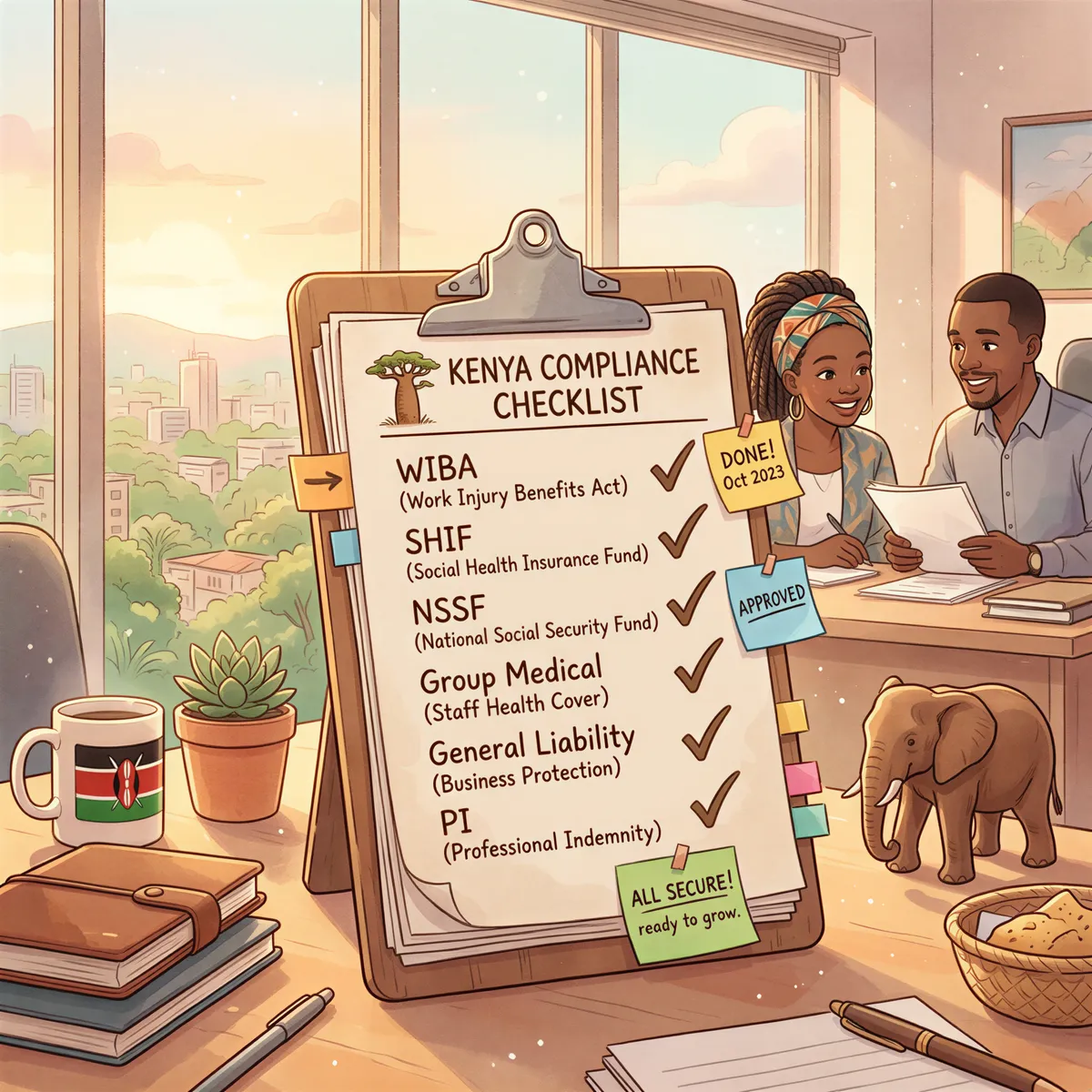
The Full Compliance Checklist
Here's your at-a-glance list:
| Insurance/Contribution | Legally Required? | Who Needs It? |
|---|---|---|
| WIBA | ✔️ Yes | Every employer, from 1 employee |
| SHIF contributions | ✔️ Yes | Every employer |
| NSSF contributions | ✔️ Yes | Every employer |
| Group medical | Depends on CBA/sector | Recommended for all |
| General liability | Required for some sectors/contracts | All businesses with premises |
| Professional indemnity | Required by some regulators | Service professionals |
The Cost of Getting It Wrong
Let's be clear about what non-compliance actually looks like:
- Employee injured, no WIBA: You pay all medical costs + compensation + fine + possible jail time
- SHIF not remitted: Penalties accumulate monthly + employees lose access to SHA benefits
- NSSF not remitted: Fines + interest + damaged business reputation
- No liability cover: One lawsuit can bankrupt a small business
The irony is this: the businesses that skip insurance to "save money" are the ones that get wiped out when something goes wrong. Compliance is cheaper than crisis.
How to Get Compliant (Step by Step)
If you're reading this and realising you have gaps, here's what to do:
- Register with SHIF and NSSF — if you haven't already, do it this week
- Get a WIBA policy — contact any licensed general insurer. It's straightforward
- Review your CBA — if your employees are covered by one, check what insurance is required
- Consider group medical — even a basic plan shows employees you're serious
- Get general liability — especially if you have a physical premises or do contract work
- Check professional indemnity — if your regulator requires it, don't delay
Final Word: Compliance Isn't Just About Avoiding Fines
Yes, the penalties are real. Fines. Prosecution. Personal liability.
But beyond that — compliance protects your people. Your employees trusted you with their livelihood. The least you can do is make sure they're covered when things go wrong.
It also protects your business. One uninsured incident can undo years of hard work.
Get covered. Stay covered. It's the cost of being a responsible employer in Kenya.
🟢 What This Means for You
If you have even one employee, WIBA is legally required. SHIF and NSSF contributions must be deducted and remitted. Group medical is strongly recommended.
Start with the legal requirements. Then build from there. Your employees — and your business — will be better for it.
Ready to Get Started?
Get personalized advice and quotes tailored to your needs. No pressure, just honest guidance.
👉 Or start a chat with our assistant now.