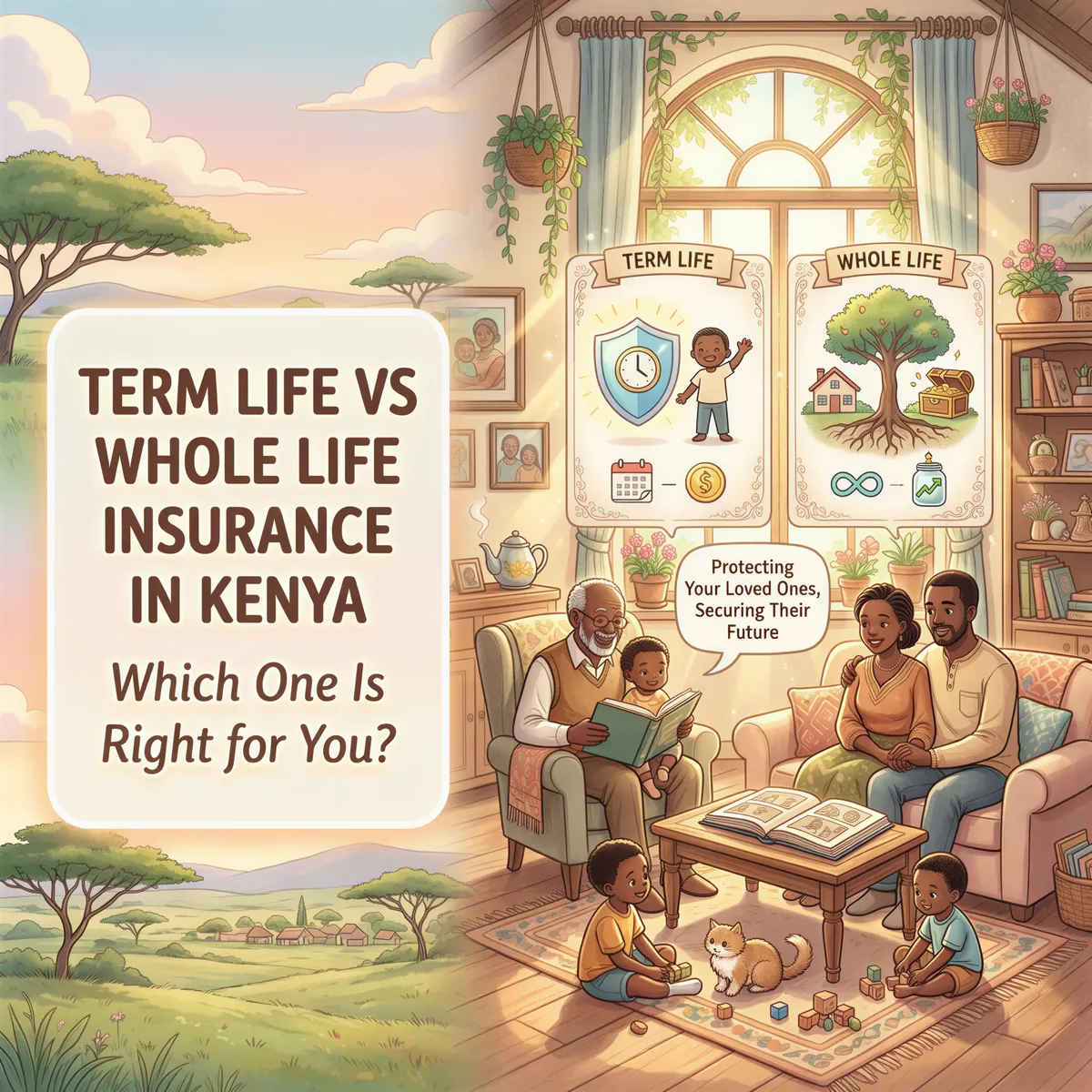
Term Life vs Whole Life Insurance in Kenya: Which One Is Right for You?
I was 28 when a friend asked me a question I had no answer for.
"If something happened to you today, how long could your family survive on what you have?"
I did the math. The answer was about four months. And that was being generous.
So I started looking into life insurance. And immediately ran into the same wall every Kenyan hits:
Term life or whole life?
The jargon. The tables. The "it depends" answers from every agent. It felt like choosing between two things I didn't fully understand.
If that's where you are, this article is for you.
Table of Contents
- What Is Term Life Insurance?
- What Is Whole Life Insurance?
- The Side-by-Side Comparison
- When Term Life Makes More Sense
- When Whole Life Makes More Sense
- The Hybrid Approach: Why Not Both?
- Five Questions to Ask Before You Choose
- Common Mistakes Kenyans Make
- Final Word
What Is Term Life Insurance?
Term life insurance is the simplest form of life cover.
You pick a period — say 10, 20, or 30 years. You pay premiums every month or year. If you die during that period, your family gets the payout. If you survive the term, the policy ends and you get nothing back.
That's it.
No savings. No investment returns. No cash value. Just pure protection.
Think of it like renting a house. You're covered while you pay, but you don't own anything at the end.
What it costs (real KSh numbers)
For a healthy 30-year-old Kenyan:
- KSh 5 million cover for 20 years: roughly KSh 3,000–5,000/month
- KSh 10 million cover for 20 years: roughly KSh 6,000–10,000/month
Premiums vary by insurer, age, and health status — but the point is, term life is affordable.
What Is Whole Life Insurance?
Whole life insurance covers you for your entire life. As long as you keep paying premiums, the policy stays active. When you eventually die — whether at 45 or 95 — your family gets the payout.
But there's a bonus: whole life policies build up cash value over time. Think of it as a forced savings account attached to your insurance.
After several years, you can:
- Borrow against the cash value
- Surrender the policy and take the cash
- Use it as collateral
Think of it like buying a house. Higher monthly payments, but you're building equity.
What it costs (real KSh numbers)
For the same healthy 30-year-old:
- KSh 5 million whole life cover: roughly KSh 10,000–18,000/month
- KSh 10 million whole life cover: roughly KSh 20,000–35,000/month
Yes, it's significantly more expensive. That's because you're paying for both insurance and a savings component.
The Side-by-Side Comparison
Here's the breakdown that actually matters:
| Feature | Term Life | Whole Life |
|---|---|---|
| Duration | Fixed (10–30 years) | Lifetime |
| Monthly cost | Lower (KSh 3K–10K typical) | Higher (KSh 10K–35K typical) |
| Payout | Only if death occurs during term | Guaranteed (whenever death occurs) |
| Cash value | ❌ None | ✔️ Builds over time |
| Flexibility | Simple, straightforward | Can borrow or surrender |
| Best age to start | 25–40 | 25–45 |
| Complexity | Low | Medium to high |
When Term Life Makes More Sense
Term life is your best friend when:
-
You're on a budget. You need maximum cover for minimum cost. A young family earning KSh 60,000–120,000/month should start here.
-
You have temporary obligations. Mortgage that ends in 20 years? Kids who'll finish school in 15 years? Match your term to the obligation.
-
You want to invest separately. Some people prefer to "buy term and invest the difference" — meaning they get cheap term life cover and put the money they save into SACCOs, money market funds, or other investments.
-
You're covering a specific risk. Business loan? Personal guarantee? Term life can be tailored to match.
Example: The Kamau Family
David and Sarah Kamau are both 32. Combined income: KSh 150,000/month. Two kids under 5. Mortgage of KSh 4 million.
They take a 20-year term life policy at KSh 10 million each. Cost: roughly KSh 12,000/month total.
By the time the term ends, the mortgage is paid, the kids are grown, and the couple has other savings. The policy did its job.
When Whole Life Makes More Sense
Whole life shines when:
-
You want a guaranteed payout. No matter when you die, your family receives money. Period.
-
You're disciplined but struggle to save. The forced savings component means you're building wealth even if you're not great at stashing cash on your own.
-
You want to leave an inheritance. Whole life is often used for estate planning — ensuring your children or spouse receive a defined sum.
-
You've already covered the basics. If you have term life, medical cover, and an emergency fund, whole life becomes a smart addition for long-term wealth building.
Example: Grace Muthoni, Solo Professional
Grace is 38, single, earns KSh 200,000/month. No kids. She supports her elderly parents.
She takes a whole life policy at KSh 8 million. It costs her KSh 16,000/month. In 15 years, the cash value will be significant — she can borrow against it if needed, or leave it as an inheritance for her nieces and nephews.
The Hybrid Approach: Why Not Both?
Here's what smart financial planners actually recommend:
👉 Get a term life policy for your high-risk years (when kids are young, debts are high).
👉 Add a whole life policy when your income grows (for wealth building and guaranteed legacy).
This way, you're covered heavily when the stakes are highest and building long-term value as you stabilize.
| Life Stage | Recommended Cover |
|---|---|
| 25–35, young family | Term life (high cover, low cost) |
| 35–45, growing income | Term life + start whole life |
| 45+, stable | Whole life (legacy and savings focus) |
Five Questions to Ask Before You Choose
Before you sign anything, ask yourself:
-
What am I protecting against? If it's temporary debt and young kids, go term. If it's lifetime legacy, go whole.
-
Can I afford the premiums for the long run? A whole life policy you can't sustain is worse than a term policy you maintain faithfully.
-
Do I have other investments? If you're already investing in money markets, SACCOs, or property, term life might be enough. If not, whole life gives you a built-in savings layer.
-
How long do my dependents need support? Think about your kids' ages. Your spouse's earning capacity. Your parents' needs.
-
What happens if I lose my job? Term life premiums are easier to maintain during financial stress. Whole life premiums can become a burden.
Common Mistakes Kenyans Make
❌ Buying whole life when they can barely afford it
The policy lapses in three years. They lose everything they've paid. Start with what you can sustain.
❌ Ignoring life insurance because "NHIF is enough"
NHIF (now SHA) is health cover. It does not pay your family a single shilling if you die. Different product entirely. Learn more in our life insurance basics guide.
❌ Not reviewing the policy as life changes
Got married? Had a baby? Bought a house? Your cover amount should change too. Review annually.
Final Word
There's no universally "better" option between term and whole life. There's only what's right for your situation right now.
If money is tight and responsibilities are heavy, term life gives you the most protection per shilling.
If you're building for the long term and want guaranteed outcomes, whole life is worth the investment.
Either way, the worst choice is no life insurance at all.
🟢 Want to dig deeper? Explore our detailed guides on Term Life Insurance and Whole Life Insurance, or read How Much Life Insurance Do You Need? to estimate how much cover your family needs.
Ready to Get Started?
Get personalized advice and quotes tailored to your needs. No pressure, just honest guidance.
👉 Or start a chat with our assistant now.