Cyber Insurance for Kenyan Businesses: What It Covers After a Data Breach

It starts with an email.
It looks like it's from your bank. Or KRA. Or a supplier you work with every week.
Someone clicks. And just like that, your business data is compromised.
Customer records. Financial information. Internal systems locked. A ransom note on the screen demanding Bitcoin.
This isn't a movie. This is happening to Kenyan businesses right now.
In 2024, Kenya recorded over 860 million cyber threat events according to the Communications Authority. SMEs, startups, e-commerce shops, logistics companies -- nobody is too small to be targeted.
And here's the scary part: most Kenyan businesses have zero insurance for this.
Let's fix that.
Table of Contents
- Why Kenyan Businesses Are Being Targeted
- What Is Cyber Insurance?
- What Cyber Insurance Covers After a Data Breach
- Real-World Scenarios in Kenya
- What Cyber Insurance Does NOT Cover
- How Much Does Cyber Insurance Cost in Kenya?
- Who Needs Cyber Insurance in Kenya?
- How to Get Started
- Final Word: The Breach You Don't Plan For Is the One That Breaks You
Why Kenyan Businesses Are Being Targeted
Kenya is East Africa's tech hub. That's great for business. It's also great for hackers.
Here's why we're a target:
- High mobile money adoption: M-Pesa processes billions daily. Where money flows, criminals follow
- Growing digital infrastructure: More businesses online = more attack surfaces
- Low cybersecurity maturity: Many SMEs don't have dedicated IT security
- Data Protection Act compliance gaps: The 2019 Data Protection Act is still being enforced unevenly
- Remote work expansion: Employees on unsecured networks are easy targets
The question is no longer "will my business be attacked?" It's "when."

What Is Cyber Insurance?
Cyber insurance is a policy designed to protect businesses from financial losses caused by cyber incidents.
Think of it as your financial safety net when technology fails or criminals succeed.
It covers costs that your general business insurance almost certainly does not cover. Standard commercial policies typically exclude cyber-related losses entirely.
For more on business insurance options, see our cyber insurance for business guide.

What Cyber Insurance Covers After a Data Breach
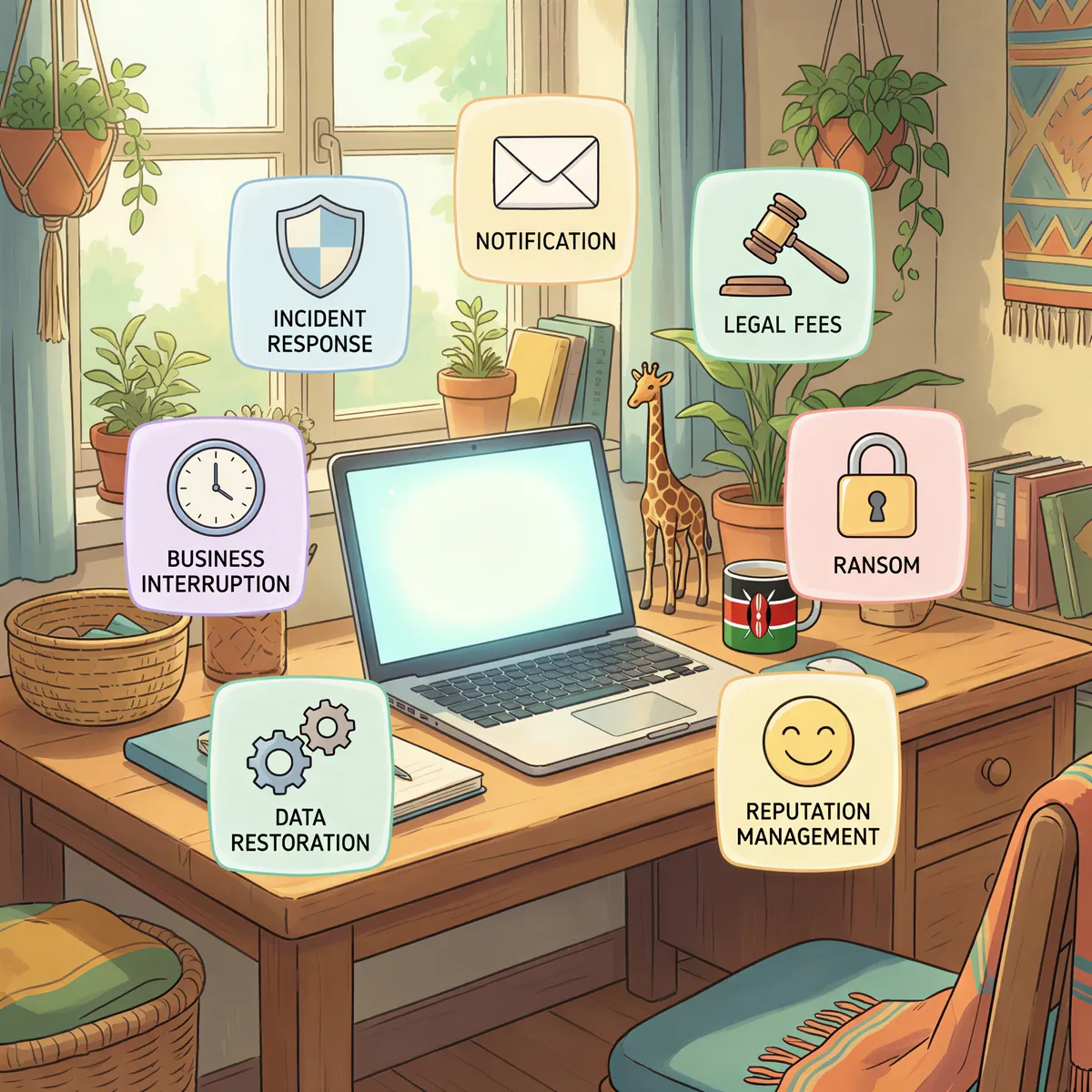
Here's where it gets practical. A data breach can trigger a cascade of costs. Cyber insurance addresses them in layers.
1. Incident Response and Investigation
The moment you discover a breach, the clock starts.
- Hiring forensic IT experts to find the source
- Determining what data was compromised
- Containing the breach to prevent further damage
Typical cost without insurance: KSh 500,000 - KSh 5,000,000+ depending on scale.
2. Notification Costs
Under Kenya's Data Protection Act, you may be required to notify:
- Affected customers and clients
- The Office of the Data Protection Commissioner
- Relevant regulatory bodies
This involves legal review, drafting notifications, setting up call centres or response channels.
3. Legal Fees and Regulatory Fines
A data breach can trigger:
- Lawsuits from affected customers
- Regulatory investigations
- Potential fines under the Data Protection Act (up to KSh 5,000,000 or 1% of annual turnover)
Cyber insurance covers legal defence costs and, in many policies, regulatory fines where legally insurable.
4. Business Interruption
If a cyberattack shuts down your systems, you lose revenue. Every hour offline costs money.
Cyber insurance covers:
- Lost income during downtime
- Extra expenses to get operations running (temporary systems, overtime, etc.)
5. Ransom and Extortion
Ransomware locks your data and demands payment to release it. Cyber insurance can cover:
- Ransom payments (where legal and as a last resort)
- Negotiation costs with threat actors
- Data recovery expenses
6. Data Restoration
Rebuilding corrupted or destroyed data:
- Restoring from backups
- Recreating lost records
- System rebuilding and testing
7. Reputation Management
After a breach, trust takes a hit. Cyber insurance can cover:
- PR and crisis communications
- Customer outreach and goodwill measures
- Credit monitoring for affected individuals
Real-World Scenarios in Kenya
Scenario 1: E-Commerce Store Breach
A Nairobi-based online retailer gets hacked. 15,000 customer records exposed -- names, phone numbers, M-Pesa details.
Costs without cyber insurance:
- IT forensics: KSh 800,000
- Customer notification: KSh 200,000
- Legal counsel: KSh 500,000
- Revenue loss (5 days offline): KSh 1,200,000
- Total: KSh 2,700,000
That can sink a small business.
Scenario 2: Professional Services Firm Hit by Ransomware
A Mombasa accounting firm's systems are encrypted. Ransomware demands KSh 3,000,000 in Bitcoin.
Costs without cyber insurance:
- Ransom negotiation specialist: KSh 400,000
- Data recovery: KSh 1,500,000
- Business interruption (2 weeks): KSh 2,000,000
- Client communication and PR: KSh 300,000
- Total: KSh 4,200,000+
Scenario 3: Employee Phishing Attack
An employee at a logistics company clicks a phishing link. Attackers gain access to the company's banking portal and transfer KSh 4,500,000 before anyone notices.
Social engineering fraud coverage (available as a rider on many cyber policies) can cover this.

What Cyber Insurance Does NOT Cover
Let's be honest about the limits:
- ❌ Pre-existing vulnerabilities you knew about and didn't fix
- ❌ Losses from unpatched systems (some policies require minimum security standards)
- ❌ Reputational damage that can't be quantified financially
- ❌ Intellectual property theft (in most standard policies)
- ❌ Infrastructure upgrades -- insurance pays to restore, not improve
Cyber insurance is not a substitute for cybersecurity. It's a complement. You still need to lock the doors.
How Much Does Cyber Insurance Cost in Kenya?
Premiums depend on:
- Your industry (finance and healthcare pay more)
- Annual revenue
- Number of customer records you hold
- Existing cybersecurity measures
- Claims history
Rough ranges for Kenyan SMEs:
| Business Size | Annual Premium | Cover Amount |
|---|---|---|
| Small (under KSh 50M revenue) | KSh 80,000 - KSh 250,000 | KSh 5M - KSh 20M |
| Medium (KSh 50M - 500M revenue) | KSh 250,000 - KSh 800,000 | KSh 20M - KSh 100M |
| Large (500M+ revenue) | KSh 800,000+ | KSh 100M+ |
Compared to the cost of a single breach, these premiums are a bargain.

Who Needs Cyber Insurance in Kenya?
If your business does any of the following, you need cyber insurance:
- Stores customer personal data
- Processes payments (M-Pesa, cards, online)
- Uses cloud-based systems
- Has employees with email access (yes, that's everyone)
- Operates an e-commerce platform
- Handles sensitive client information (legal, medical, financial)
In other words: virtually every modern Kenyan business.
How to Get Started
- Assess your risk. What data do you hold? What systems are critical?
- Implement basic cybersecurity. Firewalls, antivirus, employee training, two-factor authentication
- Talk to an agent or broker. Cyber insurance is specialised -- use someone who understands the Kenyan market
- Compare policies. Not all cyber policies are equal. Check coverage limits, exclusions, and response services
- Review annually. Your cyber risk changes as your business grows
Final Word: The Breach You Don't Plan For Is the One That Breaks You
Cyber threats in Kenya are growing faster than most businesses realise.
The CBK, the Communications Authority, and the Data Protection Commissioner are all pushing businesses towards better data governance. Compliance requirements will only get stricter.
Cyber insurance won't prevent an attack. But it will prevent an attack from becoming a business-ending financial disaster.
The businesses that survive breaches are the ones that planned for them.
🟢 What to Do Today
Ask your insurance agent or broker about cyber insurance. If they can't help, find one who specialises in commercial cyber risk.
Get a quote. Understand what you're exposed to. And stop assuming it won't happen to you.
Ready to Get Started?
Get personalized advice and quotes tailored to your needs. No pressure, just honest guidance.
👉 Or start a chat with our assistant now.